What If Paul Otlet Had AI? Making His Universal Knowledge Vision a Reality in
We live an era where digital transformation and AI systems are reshaping how organizations operate ( or will operate). The ideas of Paul Otlet, the man who wanted to classify the world, feel today more relevant than ever. Yet, many have never heard of him. Paul Otlet, a Belgian lawyer and visionary, is often considered the father of information science and the inventor of the word “documentation”. In the early 20th century, he wrote “le traité de la documentation”, his aims was to catalogue the knowledge of the world in order to make it accessible to scientists, experts but also to people outside of elite’s circles. He imagined what would later become foundational to the digital age.
Otlet designed the Mundaneum, an ambitious project originally housed in Brussels, Belgium, intended to collect and organize all the world’s knowledge. His vision was not confined to bookshelves. He foresaw universal access to information through networks, screens, and remote connections. He even drafted on paper a system of video conference linking experts form Paris to Bruxelles, concepts that closely resemble our modern web. He was not a technologist but a visionary and in his time, Otlet fought tirelessly to secure dedicated spaces for his project, often facing resistance and limited support. His grand vision of creating a city of knowledge gradually faded as his life’s work stood still in forgotten rooms, gathering dust. It was only much later, almost by accident, that this monumental effort was rediscovered by Françoise Levie. She revived and saved the work of Paul Otlet. Today, it rests in a museum in Mons (and a protected archived space), a silent testament to a dream once vivid.
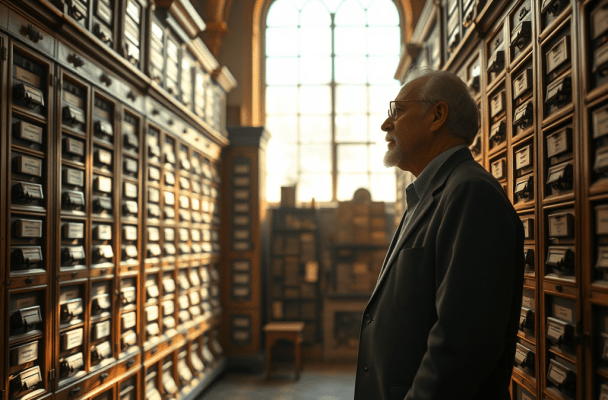
Back in 2010, while preparing a keynote on Knowledge Management for an event in Paris, I visited the Mundaneum in Mons. Surrounded by endless cabinets filled with meticulously classified index cards, I felt deeply inspired to explain the importance of taxonomies and codifications in document, information and knowledge management. These drawers in front of me reflected a time when knowledge was scarce, precious and its organization was essential. classification was not just helpful, it was key. At that time, Otlet and his team had already indexed more than 12 million documents and index cards in what they called the Universal Bibliographic Repertory. Their ambition was nothing less than to make all recorded knowledge accessible to everyone.
Yesterday, while exploring my old photography archives , I came across pictures from that visit. Seeing those wooden cabinets again triggered a new perspective. ( how many of this drawers would be needed today to store the documents, books produced daily on earth?) Today, we face an overwhelming abundance of information. The challenge has shifted. We are no longer struggling to gather knowledge, but rather to make sense of the vast quantities available.
This thought connected me back to Paul Otlet’s vision. Though he lacked the technologies we have today, what systems would he have imagined to counter this tsunami of information ? With AI and LLMs (Large Language Models), we now have the means to classify, contextualize, and democratize knowledge on a scale Otlet could only dream of. How would he use them? Without doubt, he would see these tools as powerful allies in fulfilling his lifelong mission to make knowledge universally accessible and meaningful.
AI: The engine of dynamic classification
Otlet regarded classification as the backbone of knowledge organization. For him, without clear categorization, knowledge becomes noise, difficult to access and practically unusable. This passion for order and structure was deeply shared with his close collaborator, Henri La Fontaine, Nobel Peace Prize laureate and advocate for international cooperation through knowledge sharing. Together, they dedicated their lives to making knowledge universally accessible, believing it could foster peace and societal progress.
Otlet and La Fontaine pioneered methods to catalog the world’s information at a time when technological limitations made their task Herculean. Their creation of the Universal Decimal Classification was an attempt to bring coherence to global knowledge. However, manual processes could only go so far. If Otlet had access to today’s AI capabilities, he would not rely on human classification alone. Instead, he would deploy advanced AI systems to:
- Analyze incoming data and documents instantly.
- Suggest dynamic and context aware classifications.
- Continuously refine and evolve taxonomies and codification practices to align then with linguistic and conceptual shifts.
- For Otlet, AI would not replace codification, it would revolutionize it, making it adaptive and intelligent.
AI: An agent of deep contextualisation
Information devoid of context is meaningless. Otlet knew this well and emphasized that knowledge only becomes valuable when linked to its origin, purpose, and relevance. In the early 20th century, scientists faced this challenge daily. Imagine a researcher trying to access data about experiments done across Europe — without proper context, a figure or result could be dangerously misinterpreted. Context told them how, why, and under what conditions knowledge was produced. Otlet envisioned knowledge as interconnected, where each piece relates to others in meaningful ways, much like hyperlinks today.
With modern AI, particularly Retrieval Augmented Generation (RAG) models, this becomes achievable on a scale he could only dream of. RAG does not just retrieve documents; it brings them back with their full context — who wrote them, why, and in what circumstances. It helps users not only find information but understand and reuse it wisely. For Otlet, this would be the true realization of his idea of a living, connected web of knowledge. With modern AI, particularly Retrieval Augmented Generation (RAG) models, he would:
- Build assistants capable of deeply understanding user intent .
- Reformulate complex queries to access relevant knowledge buried in vast repositories.
- Connect facts with their origins, authors, and impact, creating richer narratives.
AI, in Otlet’s hands, would serve not as a simple search engine but as a guide through the interconnected web of knowledge.
AI: Champion of universal access and inclusion
One of Otlet’s most profound beliefs, shared deeply with his collaborator Henri La Fontaine, was in democratizing knowledge. They envisioned a world where access to information would no longer be restricted by barriers of language, geography, or social status. In their work on the Universal Decimal Classification and the broader mission of the Mundaneum, they sought to break down silos that separated disciplines, nations, and cultures. Otlet believed that knowledge should be universally accessible to foster peace and global understanding. This conviction led them to develop multilingual classification schemes and promote international bibliographic cooperation, allowing scholars from different countries to connect and access knowledge in their own languages. La Fontaine, as a Nobel Peace Prize laureate, reinforced this vision by advocating for intellectual collaboration as a tool for peace. AI, particularly through multilingual capabilities and intelligent contextualization, would today be the perfect ally in fulfilling this mission. By removing linguistic obstacles, connecting isolated knowledge domains, and making complex content accessible to non-experts, AI can make Otlet and La Fontaine’s vision of universal, inclusive knowledge a tangible reality.
- Enabling multilingual access, breaking language barriers effortlessly.
- Simplifying complex technical content so non-experts could engage with advanced knowledge.
- Creating bridges between isolated knowledge domains, removing silos that limit discovery.
Through AI, Otlet’s library would truly become universal and inclusive. This is now feasible because Large Language Models (LLMs) and Natural Language Processing (NLP) were specifically designed to address this challenge. NLP enables machines to interpret and understand human language with all its nuances, while LLMs process vast amounts of multilingual data and bridge gaps in meaning. Combined with Retrieval Augmented Generation (RAG), these technologies do not simply retrieve documents — they bring them back enriched with context and relevance. This makes breaking language barriers and connecting scattered knowledge both possible and practical, fulfilling Otlet’s vision at last.
AI: Guardian of forgotten knowledge and collective memory
Perhaps more than anything, Otlet would be troubled by today’s rapid cycle of information where data becomes obsolete almost instantly. In his time, knowledge was scarce, precious, and at constant risk of being lost. Otlet dedicated his life to avoiding this loss. He feared that without proper preservation and organization, valuable insights would vanish and future generations would be forced to reinvent solutions. His aim was clear: ensure that what already existed could be easily found, studied, and reused. AI today offers exactly the kind of solution he envisioned. It would allow him to:
- Digitize and resurrect archives, including forgotten documents and marginal notes.
- Create semantic links between historical and current knowledge.
- Build dynamic narratives showing the evolution of thought across generations.
AI would not only preserve but actively revive collective memory. In Otlet’s time, information was rare and incredibly precious. He and La Fontaine fought to ensure that this valuable knowledge would not disappear into obscurity, avoiding the need for future generations to reinvent solutions already discovered. Their work aimed to make existing knowledge visible and accessible so it could be reused and built upon. Today, AI can take this mission even further. By digitizing archives, reconnecting fragments of knowledge, and surfacing forgotten insights, AI revives not only documents but also the intellectual heritage they represent.
AI: Facilitator of collective intelligence and dialogue
Otlet believed that knowledge was not static but shaped by discussion, debate, and shared experience. He viewed this social dimension as essential to advancing human understanding. Together with La Fontaine, he worked to promote international intellectual cooperation, convinced that connecting minds across borders and disciplines could foster peace and progress. This vision resonates strongly with the “Socialization” stage of the SECI model, where tacit knowledge is exchanged through direct interaction and dialogue. In Otlet’s time, conferences, correspondence, and publications were the vehicles for such exchanges. Today, AI can support this socialization process at scale, becoming a digital facilitator of collective intelligence.
- Summarizing complex dialogues and surfacing areas of agreement or contention.
- Supporting collaborative decision making by offering well rounded perspectives.
- Acting as a neutral moderator that elevates constructive knowledge exchanges.
Beyond the Tools: Otlet’s vision reinvented for a digital world
Otlet would not see AI as a “magical” solution. He would recognize its power but also its dependence on structured, validated, and meaningful input. He would caution against the temptation to simply “point AI at everything” without careful curation. He would stress the need for knowledge validation, expert involvement, and responsible stewardship.
His approach would likely be methodical and visionary:
- Start small, perhaps in one knowledge domain or department.
- Focus on recovering and structuring meaningful data: technical reports, white papers, patents.
- Avoid unnecessary complexity. For Otlet, the technology would serve the purpose, not the other way around.
- Scale progressively as trust in the systems grows and the collective knowledge base becomes more robust.
The timelessness of Otlet’s dreams
In 2025, Paul Otlet’s vision of universal knowledge is more attainable than ever. Not because AI makes knowledge magically appear, but because AI, properly guided, can organize, contextualize, preserve, and democratize knowledge in ways he only dreamed of.
AI does not replace Otlet’s vision. It completes it. Yet, he would likely express disappointment seeing how this powerful technology is often trivialized. Instead of advancing science, fostering peace, or addressing urgent challenges like global warming, much of today’s AI is spent generating superficial content and entertainment. Otlet, who believed deeply in the societal mission of knowledge, would probably urge us to aim higher.
So, as we stand on the edge of another information revolution, the question remains: how will you use AI not just to store data, but to preserve, connect, and bring to life the knowledge that defines who we are and help solve the critical issues facing humanity?

 The Xin Fu way
Leave a comment